

The healthcare industry is undergoing one of the most complex digital transformations in its history. What was once a largely siloed ecosystem where clinicians treated patients, IT teams managed systems, and administrators handled operations has evolved into a deeply interconnected digital environment. Electronic Health Records (EHRs), AI-driven diagnostics, telemedicine platforms, wearable devices, cloud infrastructure, and data interoperability frameworks are now foundational to modern healthcare delivery. At the center of this transformation lies a critical talent shift: the rising demand for cross-functional experts in Healthcare IT.
Healthcare organizations today need individuals who operate at the intersection of healthcare, technology, data, compliance, and business strategy. This convergence is redefining roles, reshaping hiring priorities, and exposing a widening talent gap that traditional skill models can no longer fill.
This week, The People Weekly by PeopleLogic, examines why cross-functional expertise is becoming critical to driving innovation and impact across Healthcare IT.
Healthcare IT: From Support Function to Strategic Backbone
Historically, IT in healthcare played a support role, maintaining servers, ensuring system uptime, and digitizing records. That perception has fundamentally changed. Healthcare IT is now a strategic backbone, directly influencing patient outcomes, operational efficiency, regulatory compliance, and financial sustainability.
According to Gartner, healthcare IT spending will continue to grow worldwide , reaching $444.2 billion by 2029. This growth is largely driven by sustained investments in services and software, which are expected to grow at a five-year CAGR of 8.6% and 10.1%, respectively, through 2029.
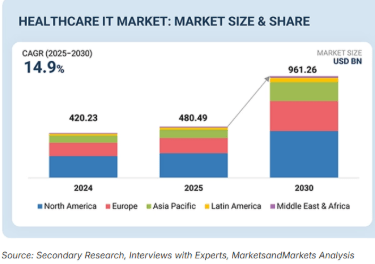
Modern healthcare systems rely on real-time data exchange between hospitals, labs, pharmacies, insurers, and patients. Clinical decisions increasingly depend on analytics, AI models, and decision-support systems. Cybersecurity failures can compromise patient safety. Poor system design can lead to clinician burnout. Regulatory misalignment can result in massive penalties.
The Talent Implications of Healthcare IT Growth
As healthcare technology ecosystems expand in scale and complexity, the limitations of siloed expertise are becoming increasingly visible.
A data scientist without regulatory understanding, an IT architect without clinical workflow insight, or a compliance officer without technical fluency can inadvertently create friction rather than progress.
Healthcare IT transformation is no longer a series of isolated technical upgrades; it is an enterprise-wide redesign of how care is delivered, financed, secured, and optimized.
This shift is precisely why cross-functional expertise is emerging as one of the most valuable capabilities in Healthcare IT.
What Defines a Cross-Functional Healthcare IT Expert?
A cross-functional Healthcare IT professional is not a generalist with shallow knowledge. Instead, they are T-shaped professionals, with deep expertise in one domain and working knowledge across multiple others.
These individuals typically combine skills across four key dimensions:
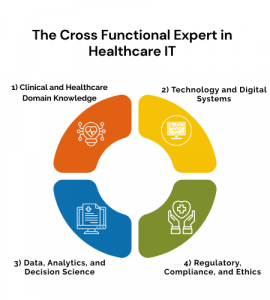
Clinical and Healthcare Domain Knowledge
Understanding patient journeys, clinical workflows, care protocols, and healthcare delivery models is essential. This does not require being a clinician, but it does demand fluency in healthcare operations and terminology.
Technology and Digital Systems
This includes familiarity with EHR systems, interoperability standards (HL7, FHIR), cloud platforms, AI/ML applications, cybersecurity, and software development lifecycles specific to healthcare environments.
Data, Analytics, and Decision Science
Healthcare runs on data, patient records, imaging, genomics, claims, and population health metrics. Cross-functional experts can translate raw data into actionable insights while maintaining data integrity and privacy.
Regulatory, Compliance, and Ethics
Healthcare IT operates under strict regulatory frameworks such as HIPAA, GDPR, and country-specific health data laws. Understanding compliance, risk management, and ethical implications is non-negotiable. The real value lies not in mastering all four areas equally, but in connecting them meaningfully.
IBM’s Cost of a Data Breach Report consistently shows healthcare as the most expensive industry for breaches — averaging $10.9 million per incident — highlighting the stakes at the intersection of IT and risk. (Source)
Key Drivers Fueling the Demand for Cross-Functional Talent
Several macro and industry-specific trends are accelerating the need for cross-functional Healthcare IT expertise.
Digital-First Care Models
Telehealth, remote monitoring, and virtual care platforms require professionals who understand both patient experience and system architecture. Designing these solutions without a clinical context leads to poor engagement and limited outcomes.
Data Explosion and AI Adoption
Healthcare generates massive volumes of structured and unstructured data. AI tools promise predictive diagnostics and personalized care, but only when data scientists, clinicians, and IT teams collaborate effectively. Cross-functional professionals enable this convergence.
Interoperability and Integration Challenges
Healthcare systems are notoriously fragmented. Integrating legacy systems, third-party platforms, and new digital tools requires professionals who understand technical integration as well as care coordination realities.
Rising Cybersecurity and Privacy Risks
Healthcare data breaches are among the most damaging and expensive. Security strategies must balance protection, usability, and compliance—something only cross-functional experts can navigate effectively.
Value-Based Care and Cost Pressures
As healthcare shifts from volume-based to value-based models, technology must support outcomes tracking, population health management, and cost optimization. This demands alignment between IT systems and financial objectives.
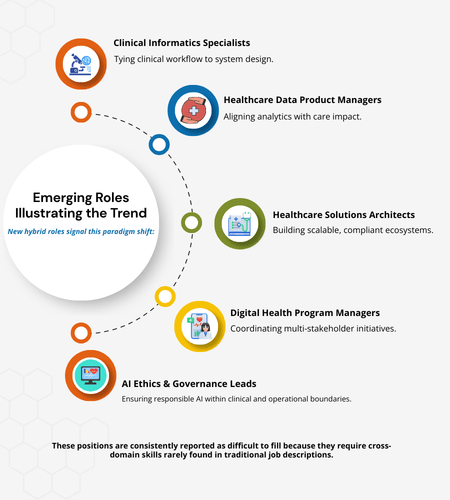
How Organizations Build Cross-Functional Capability
Leading healthcare organizations are moving beyond traditional hiring models and rethinking how they develop talent.
Investing in Internal Skill Mobility
Developing internal talent by enabling clinicians to master digital technologies and engineers to understand healthcare workflows fosters deep, context-driven expertise. This blended knowledge, built over time within the organization, is difficult to achieve through external hiring alone and gives teams a stronger ability to design, implement, and scale solutions aligned with real clinical needs.
Encouraging Cross-Team Collaboration
Initiatives such as rotational assignments, cross-functional project teams, and collective ownership of outcomes play a vital role in dismantling organizational silos. By encouraging collaboration across disciplines and shared responsibility, these approaches cultivate systems-level thinking, enabling teams to better understand interdependencies and design more integrated, effective solutions across the organization.
Redefining Job Roles and Career Paths
Strict, narrowly defined job descriptions unintentionally filter out capable, high-potential talent. By adopting more flexible role frameworks and embracing hybrid career paths, organizations can attract professionals who thrive at the intersection of disciplines, bring adaptable skill sets, and are motivated to contribute across multiple domains rather than within traditional boundaries.
Partnering with HealthTech Ecosystems
Partnerships with startups, universities, and technology providers introduce teams to fresh perspectives and innovative approaches. These collaborations accelerate the blending of skills across domains, helping organizations learn faster, adopt new capabilities, and foster a culture of continuous knowledge exchange that drives more integrated and forward-looking solutions.
The Future of Healthcare IT Talent
As healthcare continues to digitise, the importance of cross-functional expertise will only grow. The future will favor professionals who can:
Design patient-centric digital experiences
Ensure ethical and responsible AI adoption
Strengthen data security and trust
Drive operational efficiency
Enable scalable, sustainable care models
In an industry where human lives intersect with digital systems every day, the ability to “see the whole picture” is no longer optional — it is essential.
Conclusion
The rising demand for cross-functional talent in Healthcare IT highlights a fundamental reality of modern healthcare: real progress emerges at the convergence of disciplines, not in isolation. Organizations that acknowledge this shift and invest in intersectional expertise are far more likely to innovate, remain agile, and deliver impactful healthcare outcomes in an increasingly digital landscape. Those that fail to do so risk lagging not due to insufficient technology, but because they lack professionals capable of integrating systems, insights, and innovation into a cohesive whole.