

Workforce planning is the disciplined process of ensuring that an organisation has the right people, with the right skills, in the right roles, at the right time — at the right cost.
For all organisations — IT services, consulting, financial services, SaaS, professional services, R&D, shared services, corporate functions — workforce planning is not about filling seats. It is about building capability architecture.
Most companies think they are doing workforce planning. In reality, they are doing headcount budgeting.
The two are not the same.
Headcount budgeting asks:
“How many people can we afford?”
Workforce planning asks:
“What capabilities will we need to win, and how do we build or acquire them systematically?”
That distinction is strategic.
What Is Workforce Planning?
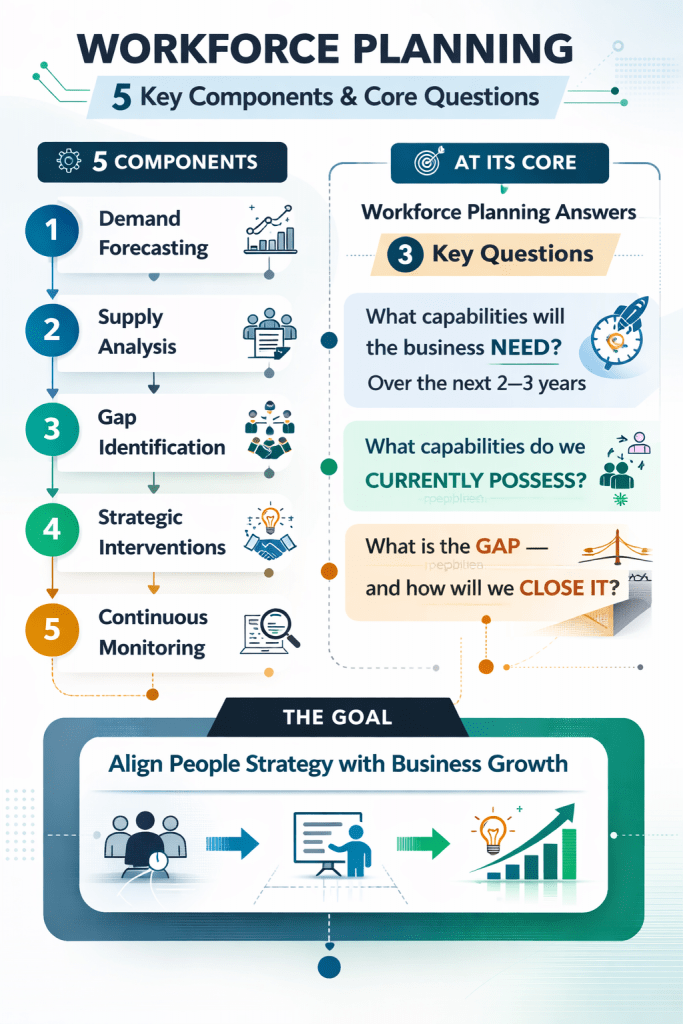
That gap can be about numbers.
More often, it is about depth, complexity, and adaptability of skills.
For example, you may already have 50 software engineers.
But if your roadmap shifts toward AI-enabled products, your requirement is no longer “more engineers.” It becomes machine learning specialists, data engineers, model validation experts, and product strategists.
Workforce planning shifts the lens from job titles to capability clusters. That level of precision determines whether planning is cosmetic or competitive.
Why Workforce Planning Is Critical in Knowledge-Based Roles
1. Skill Cycles Are Shrinking
The World Economic Forum has repeatedly highlighted that core workplace skills are evolving rapidly due to AI, automation, and digital transformation.
In professional roles:
Finance requires analytics and automation literacy.
Marketing requires data fluency and AI tool adoption.
HR requires workforce analytics and systems capability.
Engineering increasingly requires AI integration expertise.
If capability evolution is not mapped in advance, organisations end up hiring expensively and reactively.
2. Payroll Is a Major Cost Driver
In most knowledge-driven organisations, people costs form the largest operating expense.
Without structured planning, this leads to:
Overhiring during growth optimism
Layoffs during corrections
Wage inflation in high-demand roles
Underutilisation of experienced staff
Workforce planning reduces volatility and protects margins
3. Attrition Is Patterned, Not Random
In professional roles, attrition often follows:
Tenure cycles
Promotion bottlenecks
Skill stagnation
Market demand spikes
If you model these patterns, attrition becomes forecastable.
If you ignore them, it becomes disruptive.
Workforce planning incorporates historical exit data, critical role exposure, and succession mapping to reduce vulnerability.
4. Capability Depth Wins Business
In advisory, tech, SaaS, and financial services environments, clients buy competence — not resumes.
Organisations that can demonstrate structured skill depth, leadership bench strength, and succession readiness are more credible to enterprise clients and investors.
Workforce planning directly influences commercial strength.
How to Do Workforce Planning the Right Way
Here is the correct framework.
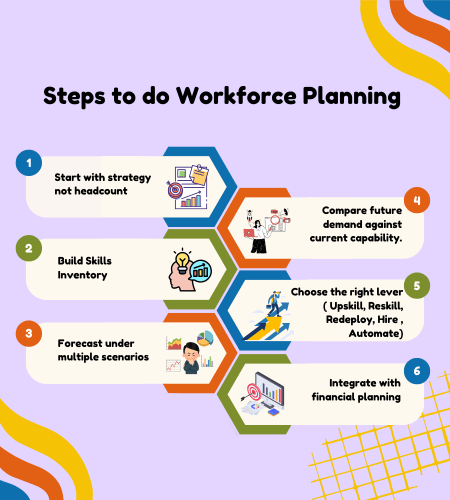
Step 1: Start With Strategy, Not Headcount
Translate business goals into capability requirements.
Ask:
What new offerings are we launching?
What technologies are we adopting?
What regulatory or compliance shifts are coming?
What scale are we targeting?
Define future capability clusters clearly.
Step 2: Build a Real Skills Inventory
Most companies avoid this because it exposes weakness.
Map:
Technical competencies
Certification depth
Project exposure
Leadership readiness
Mobility interest
Performance trajectory
Avoid relying purely on manager opinion. Use structured skill frameworks and measurable criteria.
If you cannot quantify skill distribution, you are not planning — you are assuming.
Step 3: Forecast Under Multiple Scenarios
Never build a single forecast.
Model:
Conservative growth
Expected growth
Aggressive expansion
For each scenario, estimate:
Skill volume required
Seniority distribution
Productivity assumptions
Geographic distribution (if relevant)
Scenario modelling converts workforce planning into strategic risk management.
Step 4: Conduct Gap Analysis
Compare future demand against current capability.
Gaps can be:
Quantitative (shortage of specialists)
Qualitative (skills outdated)
Leadership gaps (no successors)
Productivity gaps (underutilisation)
Attach business impact to each gap.
Revenue at risk.
Client exposure.
Compliance risk.
Without business linkage, planning remains theoretical.
Step 5: Choose the Right Lever
There are only five real levers:
Upskill
Reskill
Redeploy
Hire
Automate
Most organisations default to hiring. That is the most expensive option.
Effective workforce planning prioritises internal development and redeployment before external recruitment.
Step 6: Integrate With Financial Planning
Workforce planning must align with:
Budget cycles
Revenue targets
Investment plans
Performance reviews
If workforce planning is disconnected from financial planning, it becomes an HR document rather than a strategic tool.
Common Failures
Let’s be direct:
Confusing hiring plans with workforce strategy
Conducting planning once a year instead of continuously
Ignoring internal capability data
Treating attrition as unpredictable
Failing to quantify business risk
Leaving ownership solely with HR
Workforce planning must be business-led and data-informed
Metrics That Matter
Track:
Capability coverage ratio
Critical role exposure
Internal mobility rate
Time to proficiency
Cost per capability acquisition
Productivity stability
These metrics reflect structural health — not just recruitment efficiency.
Final Perspective
In knowledge-intensive environments, competitive advantage is intellectual, not physical.
That advantage erodes quickly without deliberate capability architecture.
Workforce planning is the mechanism that converts ambition into executable structure.
Without it, strategy remains presentation slides.
With it, strategy becomes operational reality.