

A few weeks ago, the quick service restaurant (QSR) industry was abuzz with the merger between Devyani International and Sapphire Foods — a consolidation that will create India’s largest QSR platform, with over 3,000 stores and consolidated revenues exceeding ₹7,800 crore.. This consolidation was more than corporate reshuffling; it signaled scale, investor confidence, and structural maturation in the QSR sector.
This momentum is hardly an isolated development. Jubilant FoodWorks has announced plans to open 250 new Domino’s outlets and 30 Popeyes restaurants across India while QSR chain Wow! Momo has secured ₹75 crore in fresh funding aimed at scaling operations. Across the space, expansion pipelines are aggressive, capital deployment is strong, and penetration into Tier 2 and Tier 3 Indian markets is accelerating.
But behind every store opening lies a far more complex equation — talent.
Rapid expansion in the QSR sector is not just a real estate or supply chain challenge. It is fundamentally a people’s challenge. Scaling from hundreds to thousands of outlets requires a robust frontline workforce, agile store managers, regional leadership depth, and a hiring engine capable of delivering at speed without compromising service standards. As the QSR landscape grows, the critical question is no longer merely how fast brands can expand — but how strategically they can attract, train, and retain the workforce necessary to sustain that expansion.
In this edition of The People Weekly, an endeavour by PeopleLogic we examine the rapid growth of the QSR industry and the workforce strategies underpinning it.
Quick Service Restaurants (QSR): Definition and Market Growth
What Is a QSR?
QSR stands for Quick Service Restaurant — a foodservice format built around speed, standardized preparation, and scalability. Unlike traditional restaurants that emphasize table service and customizable menus, QSRs prioritize efficiency, consistency, affordability, and quick customer turnover.
Although “fast food” and “QSR” are often used interchangeably, there is a key distinction: fast food describes the cuisine style, while QSR defines the business model — one based on repeatable processes, systemized service, and high volume throughput.
Global Market Projections
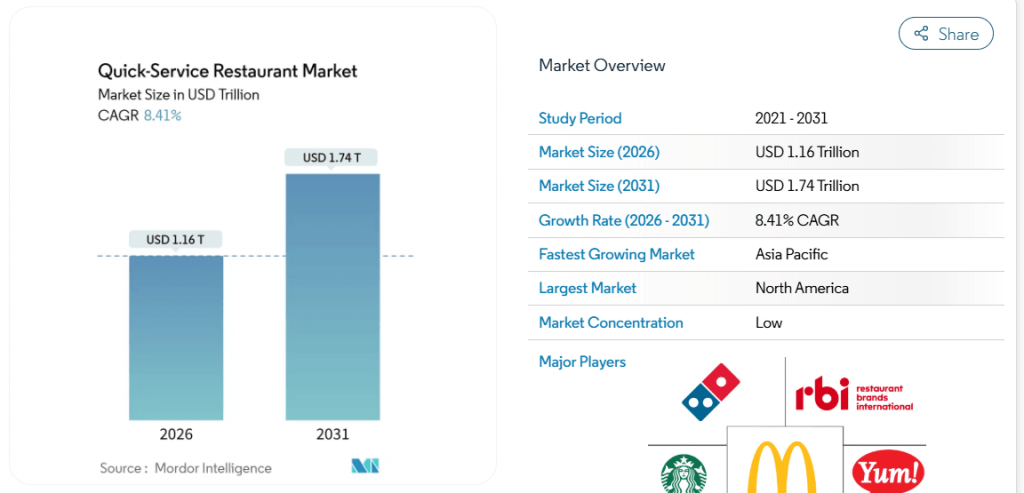
Globally, the QSR industry continues to demonstrate resilience and adaptability. According to industry analysts, the global QSR market is projected to grow at a compound annual growth rate (CAGR) of ~10% and is expected to reach USD 520 billion by 2033 [6]. This growth is driven by demographic shifts, urbanization, changing consumer lifestyles, and digital convenience.
Key drivers include:
Rising urban populations with limited time for traditional dine-ins
Increased smartphone penetration and online ordering
Expansion of delivery and cloud kitchen models
Integration of digital loyalty and self-service systems
These trends are not limited to developed markets — emerging economies in the Asia Pacific, Africa, and Latin America are significant contributors to global QSR expansion.
India’s QSR Growth Story
India is among the most dynamic QSR markets in the world. Industry estimates show the Indian QSR industry growing at 16–19% annually, with over 850 new outlets launched in the past two years alone . Analysts project that the organized Indian foodservice sector — with QSRs as a major component — could exceed USD 125 billion by 2030 .
This growth is supported by:
Rising disposable incomes
Young and urbanizing demographics
Increasing presence of international and domestic QSR brands
Expansion into Tier 2 and Tier 3 cities
India’s QSR sector is also benefiting from technology adoption — digital ordering, mobile payments, and loyalty apps — which has reshaped consumer behavior and expanded customer reach.
Hiring Landscape in the QSR Domain
As QSR chains expand, the nature of hiring is evolving. The traditional volume-driven hiring model is giving way to a more strategic, skills-centric, and digitally enabled approach.
Evolution of Roles: Pre-2020 vs. 2026
This transformation reflects broader economic and technological shifts in the industry.
Key Drivers of Talent Change
1. Digital Transformation
The pandemic accelerated digital adoption. Self-service kiosks, mobile ordering, delivery integrations, and backend analytics systems have become staples in modern QSR operations. McKinsey reports that foodservice digital sales and engagement platforms are growing faster than traditional in-store channels .
2. Economic Pressures and Profitability Focus
Rising costs of labor and raw materials have made unit economics a central concern. QSR brands are increasingly looking for multi-unit operators and analysts who can use data to improve labor forecasting, reduce waste, and optimize pricing dynamics
3. AI and Automation
Industry research suggests that up to 30% of routine operational tasks in foodservice could be automatable through AI and robotics — freeing human talent for higher-value strategy and customer engagement roles
4. Skills Gap and Talent Scarcity
India alone faces an estimated shortage of 350,000 frontline and supervisory roles as QSR brands expand aggressively. Demand for roles such as digital ops managers, CRM analysts, and technology-savvy supply chain specialists is rising faster than traditional hire availability.
Global Hiring Trends in QSR
Across regions, QSR brands are adapting their talent strategies:
North America: Integration between convenience retail and foodservice is reshaping labor functions, emphasizing cross-channel talent
Asia Pacific: Hiring optimism remains strong, with a focus on reskilling for digital transformation and customer experience enhancement
Gulf Cooperation Council (GCC): Leveraging cross-border supply and operations talent to support mega hospitality projects
Latin America and Africa: Formalization of the sector is creating remote and hybrid talent pipelines, often supported by nearshoring strategies.
The global shift favors resilient leaders with strategic oversight rather than purely execution-oriented managers.
India: Talent Opportunities and Challenges
India’s QSR boom has created a dual talent challenge:
Scale Hiring: Recruitment for entry and mid-level operational roles to staff new outlets.
Specialized Hiring: Filling white-collar roles with digital, analytical, and managerial capabilities.
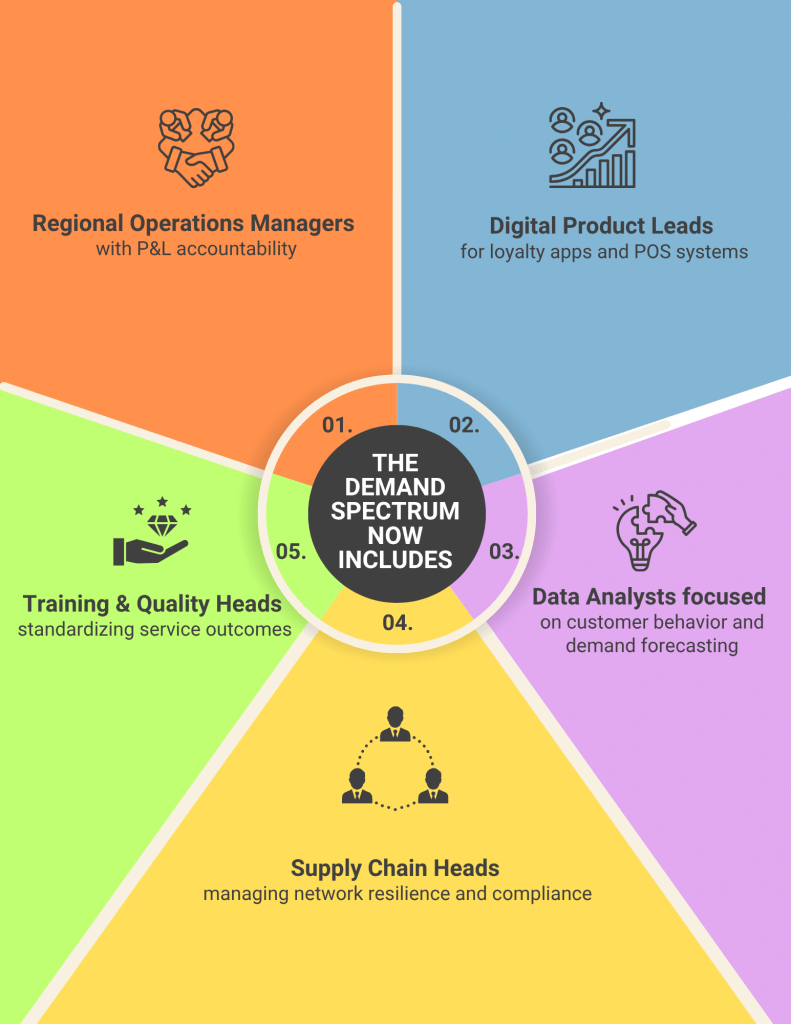
These hybrid roles require combinations of traditional QSR expertise, digital literacy, and analytics. Employers increasingly prefer candidates with cross-functional fluency rather than narrow experience.
Strategic Implications for QSR Talent Planning
For QSR brands, talent planning can no longer be a transactional exercise. It must be strategic, proactive, and growth-aligned.
Recommendations for HR / TA Leaders
Build Talent Pipelines Early: Invest in campus programs, apprenticeships, and brand-specific training academies.
Embrace Digital Skill Frameworks: Prioritize digital fluency, data analytics, and customer engagement skills in job profiles.
Redefine Leadership Criteria: Evaluate leaders for data-driven decision ability and cross-functional orientation.
Continuous Reskilling: Implement on-the-job learning to keep pace with technology changes.
Leverage Technology in Hiring: Use AI sourcing, predictive analytics, and digital assessments for faster and better talent matches.
Conclusion: Growth Needs a Workforce Strategy
The QSR industry’s headline growth — funding rounds, mergers, and outlet expansions — reflects strong market momentum. But growth without a strategic talent framework risks operational inconsistency, higher attrition, and diluted customer experience.
As both global and Indian QSR markets scale, organizations that embed workforce strategy into growth planning will outperform their peers. The most successful brands will be those that anticipate talent demand ahead of expansion, integrate digital fluency into their hiring DNA, and build capability frameworks that align people with long-term business outcomes.
The question is no longer whether the QSR industry will grow — it will. The question is whether talent strategies can grow at the same pace.