
A young engineer begins her day by asking an AI assistant for market insights before logging into a dashboard that predicts supply-chain disruptions in real time. Across industries, operational leaders, developers, and business teams rely on AI systems that think, adapt, and act — not just analyze.
This isn’t a futuristic projection — it’s happening now. Enterprise AI is mainstream: organizations are moving from isolated experimentation to enterprise-wide deployments where reliability, scalability, and automation matter most. This transformation is grounded in operational frameworks like MLOps, Edge AI, and a new generation of AI skills that bridge data science with software engineering and hardware integration.
Strong adoption signals support this shift. According to a recent national AI ecosystem report, about 87% of Indian enterprises are actively using AI solutions, and India’s broader AI market is projected to grow rapidly over the next few years. Enterprise adoption is driving both near-term productivity and long-term innovation strategies globally and within India’s digital economy. (source)
This week, The People Weekly powered by PeopleLogic examines how MLOps, Edge AI, and emerging skills are driving India’s rapidly evolving AI transformation.
From Experimentation to Deployment: The Enterprise MLOps Shift
For years, AI teams built promising models that lived only in notebooks or pilot silos. But as enterprises accumulate data and seek recurring value from AI, the trend is clear: AI must run reliably in production.
This shift is supported by adoption data showing broad enterprise engagement with AI tools. In many sectors — tech services, BFSI, healthcare, and manufacturing — organizations are using AI for tasks ranging from risk scoring to process automation, with about 48% of key industry players having deployed AI solutions as of 2024, according to an industry study. (The Economic Times)
At the heart of production-ready AI is MLOps — a discipline that ensures models are integrated into robust pipelines with monitoring, automation, and governance.
How Enterprises Are Using MLOps at Scale
MLOps elevates AI from periodic experiments to enterprise-class systems:
Financial Services: AI-driven fraud detection and risk scoring are now updated more frequently and automated through continuous integration processes.
Healthcare: Diagnostic and clinical support systems use tracked deployments and model governance to meet regulatory and operational standards.
Manufacturing: Predictive maintenance models feed real time sensor data into plant operations, reducing unplanned downtime and improving throughput.
These applications illustrate how MLOps turns AI into repeatable value creation mechanisms rather than one-off proofs of concept.
MLOps Market Growth
The global MLOps market size was valued at USD 1.58 billion in 2024. The market is projected to grow from USD 2.33 billion in 2025 to USD 19.55 billion by 2032, exhibiting a CAGR of 35.5% during the forecast period. North America dominated the global MLOps market with a share of 36.21% in 2022. (Source )
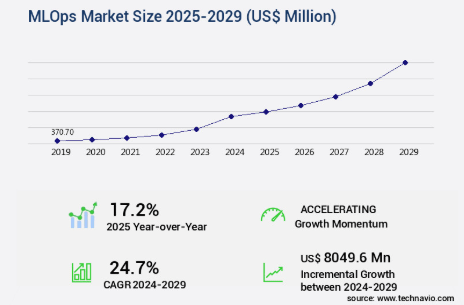
India’s MLOps market was valued at approximately USD 49 million in 2024 and is projected to grow to USD 559.8 million by 2030, reflecting a compound annual growth rate (CAGR) of 50.3% between 2025 and 2030. In terms of segment, the platform was the largest revenue-generating component in 2024.
Core MLOps Skills Enterprises Now Demand
As companies embrace operational AI, the skills required extend beyond data science:
CI/CD for Machine Learning: Automated workflows that validate data, retrain models, and deploy them with minimal manual intervention.
Monitoring & Observability: Tools and practices that detect drift, latency issues, and degraded performance in live environments.
Containerization & Cloud-Native ML: Expertise with Docker, Kubernetes, and serverless frameworks that enable scale and portability.
Governance & Reproducibility: Ensuring models are auditable, compliant, and reproducible — especially in regulated sectors.
This blended skill set is a prerequisite for production-grade AI systems.
Tools Powering Enterprise AI at Scale
The MLOps ecosystem mixes open-source and enterprise platforms:
Kubeflow — Kubernetes-native pipelines
MLflow — Experiment tracking and model registry
AWS SageMaker & Azure ML — Cloud ML platforms with built-in operational tooling
Vertex AI — End-to-end machine learning platform
Such tooling enables organizations to manage the full lifecycle of AI: from experimentation to governance.
Edge AI: Real-Time Intelligence at the Source
While cloud platforms offer centralized computing power, many use cases require real-time, localized intelligence — and that’s where Edge AI excels.
Edge AI runs models directly on devices, reducing latency, improving data privacy, and minimizing cloud costs. This capability is increasingly critical for industries where real-time decisions are non-negotiable.
Enterprise use cases span:
Smart infrastructure and IoT devices
Real-time operational monitoring
Low-latency decisioning at the device level
These patterns show how Edge AI is complementing centralized AI to create responsive intelligence networks.
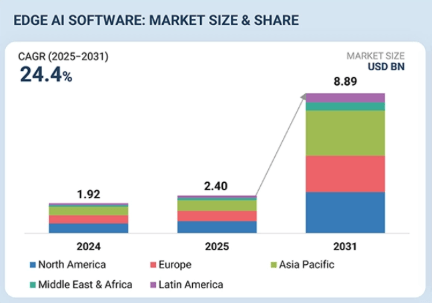
Edge AI Skills: Where AI Meets Embedded Engineering
Edge AI engineering blends AI with hardware and systems:
Hardware & Embedded Skills
Microcontrollers and processors (ARM, RISC-V)
Sensor integration and communication protocols
Power-efficient model deployment
Software & AI Engineering Skills
On-device ML frameworks (TensorFlow Lite, PyTorch Mobile)
Model compression (quantization, pruning)
Orchestration platforms (AWS IoT Greengrass, Azure IoT Edge)
Real-time operating system (RTOS) expertise
This unique skill set enables teams to deliver intelligent, efficient solutions directly on devices.
Generative and Adaptive AI: The Next Enterprise Layer
Beyond traditional predictive models, Generative AI is transforming workflows across industries. Recent research shows that in some regions, over two-thirds of digital users now rely on generative AI tools, underscoring rapid integration into productivity stacks. (The Economic Times)
Meanwhile, Adaptive AI systems — models that evolve with live data — are powering dynamic decisioning in fraud detection, demand forecasting, and personalization at scale.
Together, generative and adaptive AI are redefining operational intelligence.
AI Hiring Trends: How Enterprises Are Building AI Teams
Organizations are no longer hiring only data scientists — full-stack AI teams are becoming standard. Key roles include:
Machine Learning Engineers
MLOps & EdgeOps Specialists
AI Product Managers
Generative AI Practitioners
Cloud & AI Architects
Ethical AI and governance experts
Interestingly, adoption reports indicate a growing number of enterprises are prioritizing skill-validated work and production experience over traditional degrees — a trend mirrored globally as AI becomes operational infrastructure.
Upskilling, Reskilling & the AI Talent Imperative
As AI grows, so does the importance of talent readiness. Internal AI academies, micro-credential programs, and on-the-job learning are helping organizations close skills gaps. These efforts are essential as enterprises scale up AI use beyond pilots into everyday operations.
Conclusion: Enterprise AI Is a Skills-Led Transformation
AI’s true value lies not just in algorithms, but in how reliably and ethically they are embedded into enterprise workflows. MLOps, Edge AI, and adaptive intelligence are not just technical constructs; they represent a paradigm shift in how businesses harness real-time data to drive decisions.
Whether organizations are deploying mission-critical models, building next-generation workflows, or developing new competitive advantages, AI’s future will be powered by those who master both technology and talent.