
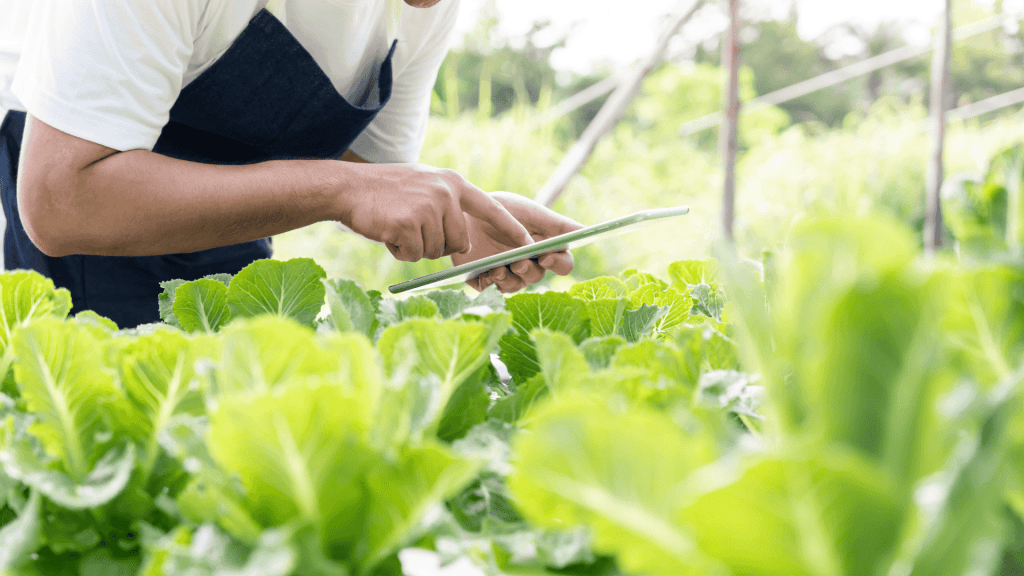
In a quiet village, a farmer checks her phone and sees a weather alert, a soil-moisture update, and a recommendation to irrigate her crops in the next hour. Hundreds of kilometres away, a data analyst studies satellite imagery that reveals early signs of pest stress across thousands of hectares. Meanwhile, a machine-learning engineer fine-tunes a crop-yield prediction model to reflect shifting seasonal patterns.
This isn’t science fiction. It’s today’s agriculture.
Across India—and much of the world—farming is rapidly evolving into a technology-driven ecosystem. As AI, drones, IoT, and data analytics move from labs into fields, agritech is not only transforming how food is grown, but also creating entirely new career pathways that blend traditional agriculture with modern technology.
For decades, agriculture relied heavily on experience, intuition, and manual labour. Today, agritech platforms combine real-time soil data, satellite imagery, predictive analytics, and digital marketplaces to provide farmers with actionable insights—from irrigation scheduling to pest detection and yield forecasting. This shift is improving productivity and resilience while opening doors to tech-enabled roles that didn’t exist a decade ago.
This week, People Weekly examines how agritech is transforming traditional farming with technology and creating a wide range of new career opportunities.
A Fast-Growing Global Agritech Market
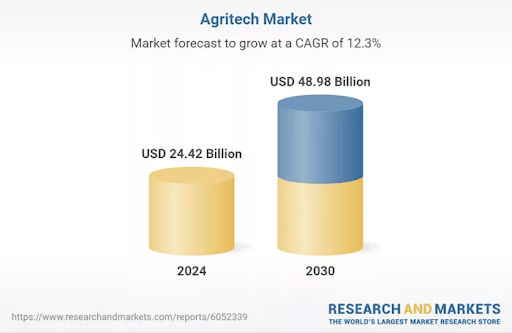
The global Agritech (Agricultural Technology) market is currently valued at approximately USD 24–28 billion (2024) and is entering a high-growth phase. Driven by food-security pressures, labour shortages, and climate volatility, the market is projected to reach USD 50–80 billion by the early 2030s, growing at a compound annual growth rate (CAGR) of 12–14%.
Key growth drivers include:
Expansion of precision agriculture solutions
Labour shortages accelerating agricultural robotics adoption
Rising demand for climate-smart farming technologies
Deeper integration of AI and data analytics across the value chain
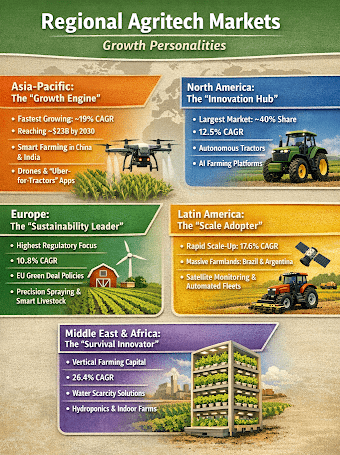
While North America currently accounts for ~40% of global market value, Asia-Pacific is the fastest-growing region, fuelled by large farming populations and rapid digital adoption in India and China.
Regional Growth Hotspots (Where the Action Is)
Asia-Pacific – The Growth Engine
Fastest-growing region globally
~19% CAGR, projected to reach ~USD 23 billion by 2030
India’s agritech sector alone is growing at ~33% annually, driven by drones, digital platforms, and service-based farm mechanisation
North America – The Innovation Hub
Largest market share (~40%)
12.5% CAGR
High adoption of autonomous machinery and AI platforms to address labour shortages
Europe – The Sustainability Leader
10.8% CAGR, driven by regulatory mandates
EU policies targeting a 50% reduction in chemical use are accelerating precision spraying and smart livestock monitoring
Latin America – The Scale Adopter
17.6% CAGR, led by Brazil and Argentina
Large-scale farms increasingly adopting satellite monitoring and IoT-enabled automation
Middle East & Africa – The Survival Innovator
26.4% CAGR in controlled-environment agriculture
Significant investments in hydroponics and vertical farming driven by water scarcity and food-security priorities
India’s Agritech Market: A High-Growth, High-Impact Ecosystem
India is now the third-largest agritech ecosystem globally, after the US and China, with 450–4,000+ agritech startups operating across the value chain.
India’s agritech market is projected to grow from ~USD 878 million (2024) to ~USD 6.15 billion by 2033
The AI-in-agriculture segment alone is forecast to expand from ~USD 467 million (2023) to ~USD 1.92 billion by 2030
Key structural growth drivers include:
Farming-as-a-Service (FaaS): Essential in a market where 86% of farmers own less than two hectares
Digital market linkages: Platforms improving farmer margins by 15–20% by reducing intermediaries
Government initiatives: Subsidised Kisan Drones and the Digital Agriculture Mission
Farmer Producer Organisations (FPOs): Aggregating demand and enabling B2B agritech adoption
New Career Frontiers: Tech + Agriculture = Tomorrow’s Roles
As agritech gains traction, a variety of new roles are opening up across the ecosystem from “in‑field tech operators” to “backend data scientists.” Some of the emerging job profiles include:
Precision Farming Manager / Farm‑Tech Manager – Professionals who oversee tech‑enabled operations like IoT sensor deployment, data‑driven irrigation scheduling, crop‑health monitoring, and yield optimisation. According to recent job‑market data, India may require tens of thousands of such professionals as agritech scales.
Drone Operator / UAV Service Provider – Drones are playing a growing role in surveying fields, spraying agrochemicals, monitoring crop health, and capturing high‑resolution imagery for analysis.
Agricultural Data Analyst / Agritech Data Scientist – With vast amounts of data coming in from sensors, satellite images, weather feeds, and supply‑chain logs, data‑analysis professionals are needed to transform raw data into actionable insights, yield forecasts, pest/disease predictions, and resource-optimisation plans.
Sustainability / Agri‑Sustainability Specialist – Experts focused on sustainable farming practices, efficient resource usage (water, fertilisers), carbon footprint management, and environmentally friendly agriculture, roles that combine agro‑ecology understanding with tech fluency.
Smart-Farming Mechanisation & Equipment Technician – As automated farm machinery, smart sensors, and robotics enter fields, skilled technicians are required to install, maintain, calibrate, and repair this equipment.
Agri‑Tech Product / Project Manager – People who can translate farmers’ needs into product requirements, coordinate between domain experts and tech teams, and lead deployment of agritech solutions end-to-end.
From Productivity to Income Stability
The adoption of agritech isn’t just creating jobs; it’s translating into real benefits for farmers and communities. AI‑powered soil sensors, crop‑health monitoring via drones, and predictive analytics help optimise water usage, reduce pesticide/fertiliser consumption, and detect early signs of disease or infestation, often before a human eye could notice.
From Yield Improvement to Income Stability
Data-driven agritech solutions are already delivering measurable outcomes:
Optimised water and fertiliser usage
Early detection of pest and disease stress
Improved yield predictability and risk reduction
These gains translate into higher productivity, improved profitability, and more stable farm incomes, reinforcing a cycle of adoption and workforce demand.
Talent Strategies for an Agritech Future
From a talent and workforce development perspective, the transformation of agriculture into a technology-first domain calls for several strategic efforts, and this is where a platform like PeopleLogic can play a vital role.
1. Build Hybrid Talent Pipelines
Agritech needs people who understand both agriculture and technology. Universities, training institutes, and skilling platforms must collaborate to create hybrid curricula blending agronomy, data science, IoT, drone operation, sustainability practices, and supply‑chain logistics.
2. Encourage Reskilling and Rural‑Tech Adoption
A large portion of India’s workforce still resides in rural areas or comes from agrarian backgrounds. Reskilling them for drone operation, sensor maintenance, data collection, and analytics could unlock massive employment potential. Public–private partnerships, state‑supported training programs, and agritech scholarships could accelerate this.
3. Promote Tech‑to‑Rural Career Transition Paths
Tech professionals from cities should be encouraged to explore agritech roles, for example, as product managers, data scientists, or equipment‑integration engineers. The social impact, combined with growth potential and demand, makes agritech a compelling career path.
4. Benchmark Standards & Certifications
To ensure quality and trust, standardised certifications for drone operators, agritech data specialists, sustainability auditors, and smart-farming technicians will help professionalise the sector and build investor confidence.
5. Strengthen Collaboration Between Stakeholders
Agritech’s success depends on collaboration among startups, government, research institutions, and the farming community. Platforms like PeopleLogic can enable transparent talent‑matching, data-driven workforce planning, and long-term tracking of skill supply and demand across regions.
What This Means for Talent and Workforce Strategy
Agritech illustrates how traditional sectors are being reshaped by technology—and how workforce strategy must evolve alongside them. The sector highlights:
Growing demand for hybrid agri-tech skill sets
Large-scale reskilling opportunities in rural and semi-urban regions
The rise of purpose-driven, sustainability-aligned careers
At PeopleLogic, we view agritech as a strong indicator of how data-driven talent intelligence can help organisations anticipate skills demand, identify gaps, and build future-ready workforces.
Conclusion
Agritech is no longer a niche—it is becoming foundational to how food systems function in a data-driven world. As investment, adoption, and innovation accelerate, the sector is quietly creating a new class of careers that blend technology, sustainability, and real-world impact.
The future of agriculture will be shaped not just by tools and platforms, but by the people equipped to scale them.