

Imagine hiring a pilot based solely on their ability to explain aerodynamics—without ever checking if they can land a plane in a storm. Absurd? Yet, this is precisely how many organizations hire today.
Most companies still rely on Job Descriptions (JDs): static lists of tasks, degrees, and years of experience, to fill roles in industries that change every six months.
In emerging sectors such as Agritech, Electric Vehicles (EV), and Generative AI, the traditional job description is not just outdated—it has become a liability. A “Senior Data Scientist” in 2024 is fundamentally different from one in 2026. When hiring focuses on pedigree (degrees and past titles) rather than potential (outcomes and adaptability), organizations end up hiring for the past, not the future.
The hiring shift required for 2026 is radical but necessary:
move from hiring for job descriptions to hiring for job outcomes.
Why the Old Model is Failing
The traditional Job Description was designed for the industrial era—stable roles, predictable tasks, and linear career paths. Today’s reality is different.
Skills Expire Faster than Tenures: The World Economic Forum predicts that 44% of workers’ core skills will be disrupted by 2027. In sectors like Agritech, a “Drone Pilot” isn’t just flying; they are analyzing multispectral data and managing autonomous fleets. A static JD cannot capture this evolution.
The “Unicorn” Trap: Hiring managers often write JDs as wish lists—”10 years of experience in Generative AI” (which didn’t exist 10 years ago). This chases away qualified talent who don’t tick every box but have the capability to deliver.
Outcome Ambiguity: Most JDs list responsibilities (“Manage the sales team”) rather than results (“Achieve 20% YoY growth in the APAC region”). This attracts “activity-focused” candidates rather than “result-focused” leaders.
The Solution: Outcome-Based Hiring (OBH)
Outcome-Based Hiring flips the script. Instead of asking, “What skills do you have?”, it asks, “What problems can you solve?” Or,“What must this person achieve in their first 12 months for this hire to be considered a success?”
Instead of listing “Proficiency in Python and Data Modeling,” an outcome-based JD might state: “Build a scalable data pipeline that reduces processing latency by 30% within the first two quarters.”
This shift changes the interview dynamic entirely. Instead of verifying what a candidate did at their last company, you are assessing their ability to navigate the ambiguity of your specific challenges.
For example:
Traditional JD: Proficiency in Python and data modelling
Outcome-Based Role: Build a scalable data pipeline that reduces processing latency by 30% within two quarters
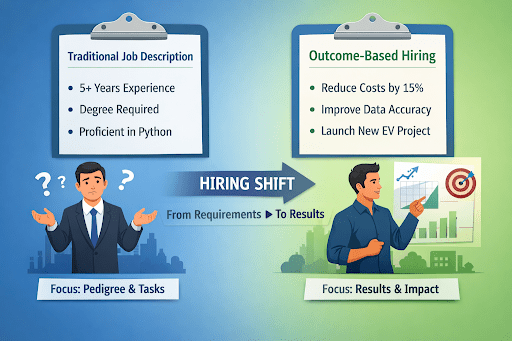
This shift changes interviews entirely. Instead of validating past experience, hiring teams assess how candidates think, adapt, and operate in ambiguity—the reality of emerging industries.
What to Look for Instead
1. Adjacent Skills and Learnability
In fast-evolving fields, the most valuable trait is cognitive agility—the ability to apply mental models from one domain to another.
A high-performing electrical engineer, for example, may have the foundational thinking required to excel in sustainable grid technology, even without a formal EV title.
The real metric to assess is rate of learning. How quickly has a candidate mastered new tools or domains in the past? This is often a better predictor of future success than legacy certifications.
2. Work Samples Over Interviews
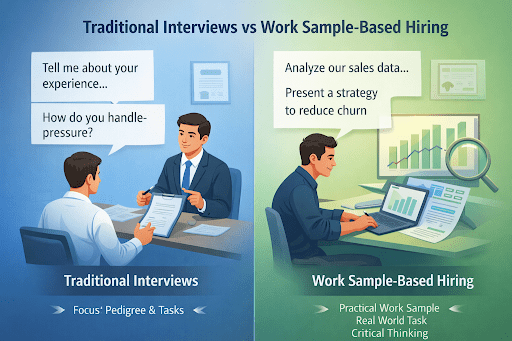
Traditional interviews often reward confidence and articulation—not competence.
Leading organizations are replacing them with realistic work samples or short trial projects. Instead of asking how a candidate handles pressure, give them a sanitized version of a real problem your team is facing. Observe how they structure their thinking, ask questions, respond to feedback, and recover when a solution fails.
This approach offers far more signal than polished interview answers.
Redesigning the Candidate Experience
For HR leaders and talent acquisition teams, outcome-based hiring requires a mindset shift.
Audit hiring requirements
Remove proxy filters such as elite degrees or rigid experience thresholds unless legally required. These often exclude cross-domain and self-taught talent—exactly the profiles that thrive in emerging industries.
Train hiring managers
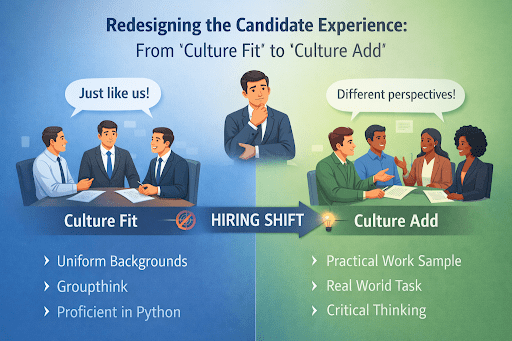
Most managers hire in their own image. They must be trained to evaluate transferable skills such as systems thinking, adaptability, and communication.
Shift from “culture fit” to “culture add”
In high-growth industries, culture fit often results in groupthink. Culture introduces diverse perspectives that drive innovation.
The ROI of Outcome-Based Hiring
Organizations that adopt outcome-focused hiring see clear advantages:
Faster time-to-productivity: New hires start with a clear success roadmap
Higher retention: People stay longer when they understand the impact they are meant to create
Greater agility: Teams defined by outcomes—not tools—pivot faster as markets evolve
A Practical Hiring Framework for 2026
Step 1: Define the “Performance Profile,” Not the Person
Stop writing lists of requirements. Start defining the 3-5 Critical Business Outcomes the new hire must achieve in their first 12-18 months.
Old Way (JD): “Must have 5+ years experience in Supply Chain Management and an MBA.”
New Way (Outcome Profile): “Within 6 months, reduce last-mile delivery costs by 15% by optimizing our EV fleet routing algorithms.”
Why it works: It opens the door to non-traditional candidates. A logistics veteran might solve this, but so might a brilliant data scientist with zero “supply chain” titles. You hire the solution, not the resume.
Step 2: The “Audition” Over the Interview
In emerging industries, past experience is a poor predictor of future performance because the problems are new. Replace generic interviews with Outcome-Based Assessments.
For a Fintech Product Role: Don’t ask, “Tell me about a time you managed a roadmap.” Give them a stripped-down dataset of your user churn and ask, “Draft a 1-page strategy to reduce this by 5% in Q3.”
For an Agritech Sales Role: Don’t ask for their Rolodex. Ask them to “Map out a go-to-market plan for our new soil sensor in the Maharashtra region.”
This “work sample” approach is 3x more predictive of job performance than standard interviews.
Step 3: Sell the Challenge, Not the Perks
Top talent in 2026 isn’t moved by ping-pong tables. They are moved by impact.
An Outcome-Based Job Post attracts better candidates because it respects their ambition.
Instead of: “We offer competitive salary and a great culture.”
Try: “Join us to build the infrastructure that will power 1 million EV scooters by 2030. Your code will directly reduce carbon emissions by X tons.”
Case Study: The “Fractional” Revolution
This shift is also driving the rise of Fractional Executives. Companies are realizing they don’t always need a “Full-Time CMO” (a title). They need “Someone to set up our MarTech stack” (an outcome).
By defining the outcome, they can hire a high-level expert for a 6-month sprint, achieving the goal faster and cheaper than a traditional permanent hire.
The HR Leader’s Action Plan for 2026
Audit Your JDs: Pick your top 3 open roles. Do they list tasks or results? Rewrite them to focus on what “success” looks like in Year 1.
Train Hiring Managers: Teach them to interview for potential. “How would you approach X problem?” is better than “Where did you go to college?”
Embrace “Skill Portability”: In Agritech and EV, talent will come from adjacent industries (e.g., Telecom engineers moving to EV charging networks). Outcome-based hiring is the only way to spot these transferable skills.
The Bottom Line:
In 2026, the strongest organizations won’t be those with the strictest hiring criteria. They will be the ones that clearly define the destination—and hire people capable of navigating uncertainty to reach it.
Let’s stop hiring for the past.
Let’s hire for outcomes.