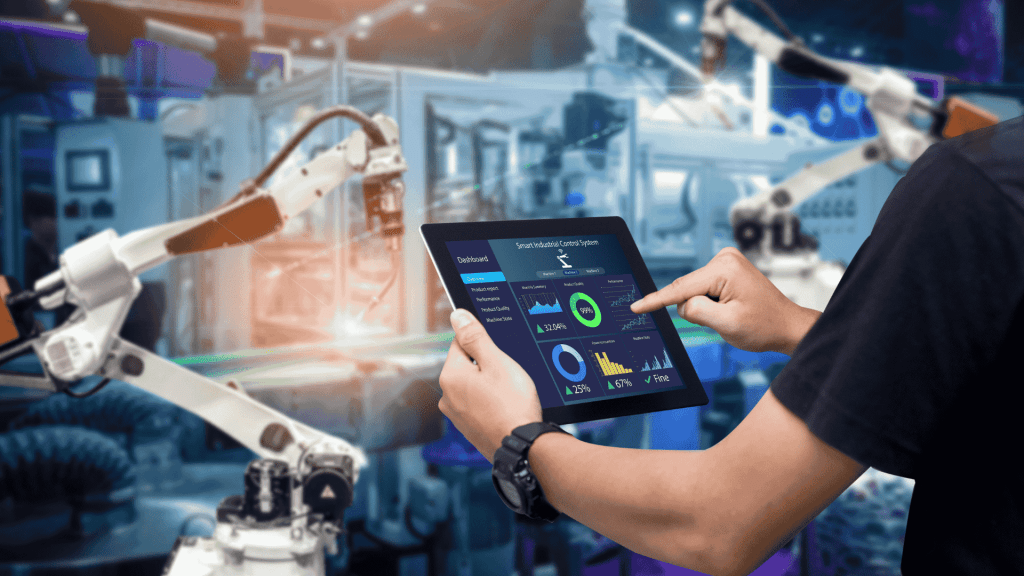
At 8:45 a.m., the factory floor is already alive.
Robotic arms glide with mechanical precision. Dashboards pulse with data—machine uptime, defect rates, energy efficiency—all updating in real time. An AI model quietly adjusts production schedules based on overnight demand forecasts.
To an outsider, it may seem like a factory that runs itself.
But in a glass-walled control room overlooking the shop floor, a young production engineer studies a sudden anomaly in the data. The numbers are technically “within range,” yet something feels off. She flags it, calls the maintenance lead, and tweaks a parameter the algorithm wasn’t trained to question. Ten minutes later, a costly line stoppage is avoided.
That’s what a smart factory truly looks like in 2025—not machines replacing people, but people empowering machines.
The popular image of Industry 4.0 often begins and ends with technology: autonomous robots, IoT-enabled equipment, digital twins, and AI-driven optimization. These tools are powerful, transformative, and undeniably essential. Yet the real intelligence of a smart factory does not reside solely in its systems—it lives in the people who design the workflows, interpret the insights, challenge the outputs, and continuously adapt technology to real-world complexity.
Because algorithms do not understand context. Sensors do not recognize intent. And automation, no matter how advanced, cannot replace human judgment when the unexpected happens.
As manufacturing enters an era defined by cyber-physical systems and real-time intelligence, the competitive edge is no longer just about who has the most advanced technology. It’s about who has the workforce capable of turning that technology into sustained performance.
In the age of smart factories, smarter people are not optional; they are the operating system.
This week, The People Weekly“, empowered by PeopleLogic examines how manufacturing enters its most transformative phase, the conversation is shifting from what machines can do to what humans must become.
Technology Runs on Human Intelligence
When people talk about Industry 4.0, the conversation usually revolves around automation, robotics, IoT, and artificial intelligence. These technologies are indeed revolutionary, but the real intelligence behind a smart factory lies not in the code or the sensors—it lies in the people.
It’s people who design the workflows, interpret data, and make judgment calls when algorithms reach their limits.
Because:
Algorithms don’t understand context.
Sensors can’t detect intent.
Data doesn’t make moral or strategic decisions.
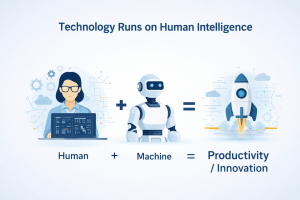
As manufacturing evolves into a world of cyber-physical systems and real-time analytics, success depends less on who has the most advanced machines—and more on who has the most adaptable minds.
From Mechanization to Intelligence
The industrial revolution has come a long way. The first brought mechanization through steam power. The second gave rise to mass production through electricity. The third—the digital era—introduced computers and automation.
Now, Industry 4.0 connects machines, systems, and people through IoT, AI, robotics, cloud computing, and digital twins.
Factories have transformed from isolated production units into intelligent ecosystems that monitor, analyze, and optimize themselves.
The numbers tell the story:
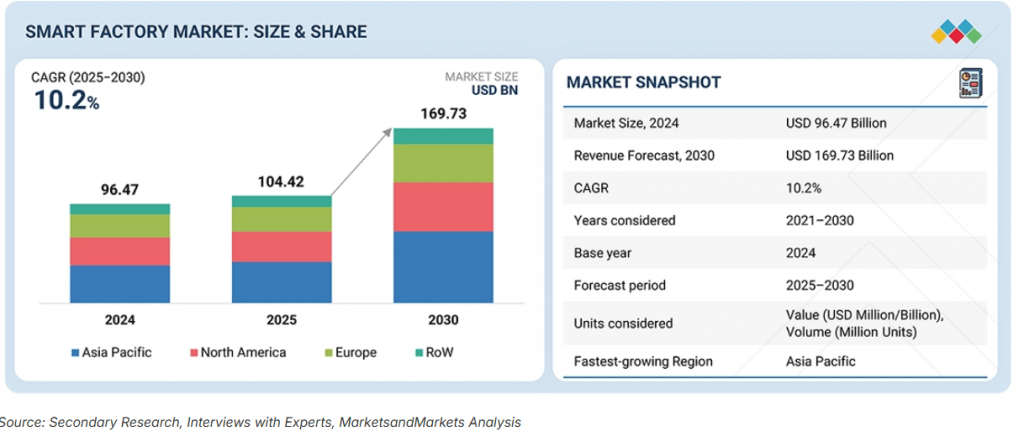
The global smart factory market is valued at USD 104.42 billion in 2025 and projected to reach USD 169.73 billion by 2030 (CAGR 10.2%).
In India, IoT manufacturing solutions are expected to reach $15 billion by 2025, driven by Production Linked Incentive (PLI) schemes that have attracted over $18 billion in investments and created 9.5 lakh jobs.
Yet amid this transformation, one truth remains constant: while machines can execute, only people can innovate.
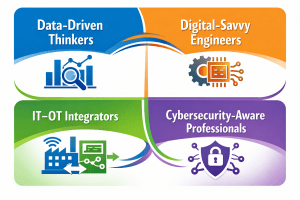
The Emerging Workforce of Smart Factories
Smart factories demand a new generation of professionals—those who combine technical expertise with creativity, critical thinking, and adaptability.
Bridging the Skills Gap Between Machines and People
Technology evolves faster than traditional workforce models can adapt. Many manufacturing professionals were trained in an era before AI, IoT, or predictive analytics. Expecting them to instantly adjust is unrealistic.
According to the World Economic Forum, 60% of jobs will require upskilling by 2025. This shift could generate a net gain of 12 million new roles globally—but only for organizations that invest in skill transformation.
In India, while 5 million tech professionals are leading global AI innovation, small and medium enterprises—contributing nearly 30% to GDP—often lack access to structured training.
Forward-looking manufacturers are bridging this divide through:
Continuous digital learning programs
Hands-on exposure to smart factory tools
Cross-functional collaboration between production, IT, and analytics teams
Partnerships with academic and technology institutions
Human Judgment in the Age of Intelligent Manufacturing
Despite rapid progress in AI, human judgment remains irreplaceable. Algorithms can predict anomalies, but they can’t interpret intent or understand trade-offs. Strategic decisions—such as prioritizing quality over speed or balancing sustainability with profitability—still rest on human insight.
This evolving collaboration between humans and machines, often called augmented intelligence, is where real value emerges. As automation scales, the demand for human-centric skills—communication, critical thinking, and leadership—rises even higher.
Redefining Leadership for Industry 4.0
Leaders in smart factories are no longer just efficiency managers—they’re change architects.
They must balance data-driven decision-making with empathy, guiding teams through transformation while building trust between people and technology.
Modern manufacturing leadership means fostering a culture of innovation, encouraging collaboration across disciplines, and creating environments where employees feel empowered—not replaced—by automation.
Designing with Humans in Mind
Smart manufacturing isn’t only about machines; it’s also about human-centered design. When interfaces are intuitive and dashboards are meaningful, adoption and productivity improve.
Conclusion: The Human Operating System
Looking ahead, manufacturing success will be defined not by how advanced the machines are, but by how capable the people behind them become.
Industry 4.0 is not a choice between human effort and technology—it’s a partnership.
Machines bring precision and scale; humans bring creativity, judgment, and purpose.
At PeopleLogic, we believe the future of manufacturing belongs to organizations that invest equally in both.
Because while automation builds efficiency, people build possibility.