
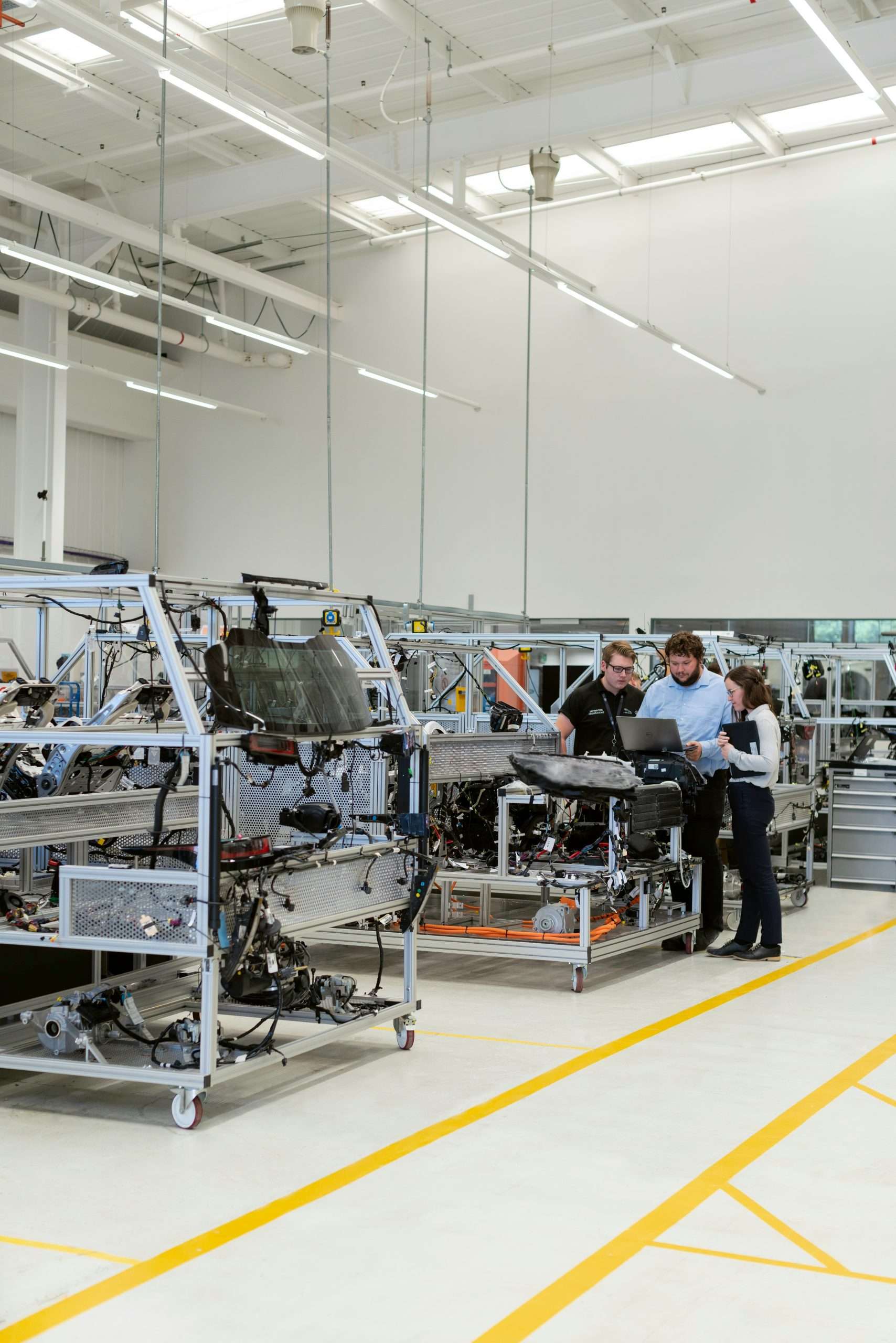
Why Global Manufacturers Are Setting Up GCCs in India — And What They're Struggling to Find
When global manufacturing leaders gather in boardrooms in Basel, Stuttgart, Tokyo, or Melbourne today, the conversation has shifted. The question on the table is no longer whether to build in India — it is what more can we build from India?
And the companies asking that question are no longer just banks and software firms. Steelmakers, biopharma giants, automotive conglomerates, semiconductor companies, and industrial manufacturers are arriving in India at a pace that is reshaping what GCCs look like — and what they need to hire. Global Capability Center recruitment in India has never been more competitive — or more consequential.
BY THE NUMBERS
The Scale of India’s GCC Market in 2026
Global Capability Center recruitment in India is at an inflection point — having already reached US$64 billion in annual revenue, growing at a CAGR of 9.8% over the past five years and well ahead of earlier projections. By 2030, the market is expected to cross US$100–110 billion, with India hosting 2,200–2,500 GCCs and employing up to 2.8 million professionals.
The NASSCOM Annual Strategic Review 2025 identified Engineering R&D — the engine of manufacturing GCCs — as one of the key growth hotspots driving India’s technology industry past the $282 billion revenue mark in FY2025.
Over 85% of global organisations with ER&D activity already leverage a GCC for it, with approximately 75% of such centres located in India. More than 70% of organisations with India ER&D presence planned to increase their spend — with nearly half planning increases of more than 10%.
This is not marginal growth. It is a structural commitment. For global manufacturers navigating this shift, finding the right GCC hiring services in India has become as strategic a decision as the GCC setup itself.
The pull factors
Why Manufacturers Specifically Are Coming Now
The China+1 Mandate and PLI Incentives
Geopolitical pressure made single-country manufacturing dependency untenable. India's PLI scheme covers 14 strategic sectors with ~USD 26 billion outlay. As of December 2025, PLI has attracted ₹2.16 lakh crore in committed investments and created over 14 lakh direct and indirect jobs.
Manufacturers following their supply chains into India are building engineering, R&D, and operations intelligence hubs — not back-office units.
India's ER&D Depth Is Unmatched
India produces approximately 2.5 million STEM graduates annually. The depth of available talent in manufacturing-adjacent domains — embedded systems, industrial automation, supply chain technology — has grown significantly in the past five years.
Innovation Logic Has Replaced Cost Logic
According to the EY GCC Pulse Survey 2025, 58% of Indian GCCs are investing in agentic AI and 83% are scaling generative AI projects. Manufacturing GCCs are being tasked with ER&D, digital transformation, and in many cases global product ownership.
Talent Intelligence
What Manufacturing GCCs Are Actually Hiring For
The in-demand roles broadly fall into four clusters:
- Automation engineers
- Robotics programmers
- EV powertrain engineers
- PLC/SCADA specialists
- Quality engineers
- Industrial IoT architects
- Supply chain data scientists
- Digital twin engineers
- AI/ML engineers
- Material management
- ESG & HSE leaders
- Shop floor digitalisation
- Procurement specialists
- Manufacturing cost accounting
- Complex workforce HR
- Cross-border compliance
The Hard Truth
The Talent Gap: Why Finding This Talent Is Harder Than It Looks
Here is the uncomfortable truth that every manufacturing GCC Head of HR in India eventually confronts: the talent they need is scarce, expensive, and largely passive.
Time-to-Fill Is Broken
Industry research from 2026 shows that 58% of GCCs in India take more than 45 days to fill critical roles — slow, reactive hiring has become a strategic liability.
The Mid-Senior Band Is the Most Acute Gap
The hardest cohort to hire sits at the 8–15 years of experience level. The brief is not simply “strong automation engineer” — it is “automation engineer who has worked in automotive assembly environments.”
Manufacturing Talent Is Not in Standard IT Pipelines
Most GCC hiring partners are calibrated for IT services hiring. Manufacturing GCC talent — ER&D leads with automotive validation experience, Quality 4.0 specialists with Six Sigma and machine learning credentials — is simply not in those pipelines.
Attrition Turns Hiring Into a Running Race
Mid-level engineering attrition in manufacturing has reached 20–24%. Manufacturing GCCs are not just building a team — they are continuously rebuilding it.
Brand Invisibility in the India Market
Mid-level engineers in India receive 5–15 recruiter messages per week. A 130-year-old European industrial giant with a household name in Germany may be entirely unknown to a mechanical engineer in Pune or Chennai. The employer branding work required to make a manufacturing GCC a “destination employer” in India is significant — and most parent companies underestimate it at the outset.
The Geography Mismatch
Manufacturing GCCs frequently want to locate near industrial clusters — Pune, Chennai, Coimbatore, Ahmedabad. But India’s deepest GCC talent pools are concentrated in Bengaluru and Hyderabad. Getting the location strategy right — which roles can be anchored in Tier-2 and which need Tier-1 depth — is a hiring decision as much as a real estate one.
What Works
What the Best-Performing Manufacturing GCCs Are Doing Differently
Working with specialists, not generalists
The answer comes down to specialist GCC hiring services — a recruiting partner with manufacturing domain knowledge who knows where ER&D leads and automation engineers are and how to position a new GCC compellingly.
Building talent pipelines before roles open
Given the 45-day+ time-to-fill reality, waiting for a vacancy to post a JD means the role is already behind schedule. High-performing GCCs map the market continuously before mandates arrive.
Structuring hiring for scale, not for individual roles
A manufacturing GCC is ramping 100–300 people across 18–24 months. That demands embedded recruitment and proactive sourcing — not transactional agency hiring.
Investing in employer brand early
GCCs winning in India have built visibility through technical blog presence, campus partnerships, and Glassdoor and AmbitionBox presence — before they needed to compete for talent.
Getting the location strategy right
Anchoring senior leadership in Tier-1 cities while building mid-level functions in Tier-2 clusters gives manufacturing GCCs both depth and cost efficiency.
“The talent brief for a manufacturing GCC is fundamentally different from a technology GCC — and it requires a recruiting partner with both manufacturing domain knowledge and deep India market expertise.”
Frequently Asked
Questions on Manufacturing GCC Hiring in India
What is a manufacturing GCC in India? +
A fully-owned strategic centre set up in India by a global manufacturer to run ER&D, engineering, supply chain analytics, and digital functions for the parent company.
Why are global manufacturers choosing India for GCCs in 2025–2026? +
Three reasons: India’s PLI scheme has unlocked ₹2.16 lakh crore in manufacturing investment, the China+1 strategy is accelerating supply chain diversification, and India’s ER&D engineering talent has matured significantly.
What roles are hardest to fill in a manufacturing GCC? +
The 8–15 year mid-senior band — automation engineers, PLC/SCADA leads, ER&D leads, and Industrial IoT architects combining manufacturing domain knowledge with digital capability. 58% of GCCs already take 45+ days to fill these roles.
How long does it take to build a manufacturing GCC team in India? +
Typically 18–24 months to reach 100–300 people. GCCs using an embedded RPO model ramp consistently faster with stronger first-year retention.
Which Indian cities are best for a manufacturing GCC? +
Pune for automotive and EV. Chennai for electronics. Bengaluru for semiconductor and AI/ML. Hyderabad for biopharma. Coimbatore and Ahmedabad for mid-level engineering at 20–30% lower cost.
How is manufacturing GCC hiring different from technology GCC hiring? +
Tech GCCs need software engineers available in large numbers. Manufacturing GCCs need those same profiles but with genuine domain knowledge — an automation engineer with assembly line experience, a data scientist who has modelled process manufacturing. This hybrid profile is scarce and absent from standard IT pipelines.
Ready to build your GCC team?
Talk to Our GCC Hiring Team
PeopleLogic provides specialist GCC hiring services across technology, BFSI, and manufacturing sectors. If you are building a manufacturing GCC in India, we would like to talk.