
At PeopleLogic, we work with hiring managers and HR leaders across industries every day. One pattern we keep seeing: the hardest roles to fill aren’t the most technical ones — they’re the hybrid ones. The data engineer who understands water systems. The project manager who can navigate municipal procurement. The UX designer who builds for 600 million city dwellers.
India’s smart city infrastructure is 94% built. The workforce to operate it is not. This week’s piece in “The People Weekly” by PeopleLogic, explores what that gap means — and what forward-thinking organisations are doing about it.
India’s urban transformation is already here
India’s urban transformation is no longer a distant promise — it is an unfolding reality. Large-scale investments in digital infrastructure, mobility, water and waste management, and citizen services are reshaping the cityscape at scale.
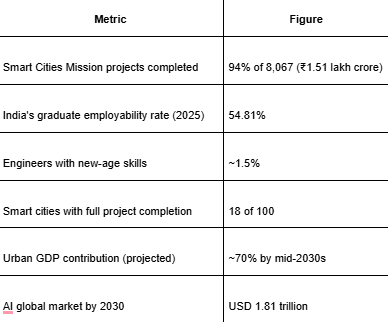
The Smart Cities Mission has a total union budget allocation of ₹47,652 crore, and as of May 2025, 94% of its 8,067 projects — worth ₹1,51,361 crore — have been completed across 100 cities. Every one of those projects creates an ongoing need for people who can operate, maintain, and evolve what has been built.
As buildings, roads, and control centres become ‘smart’, the human question intensifies: what skills will power these cities, and how will India build a workforce capable of running, maintaining, and innovating within them?
Why skills matter to the smart-city promise
Smart-city projects convert physical infrastructure into a complex socio-technical system. Integrated Command and Control Centres, IoT sensors, data platforms, AI-driven traffic management, and citizen-facing apps do not run themselves. They require engineers who design systems, technicians who maintain hardware, data professionals who interpret flows, managers who align technology with policy, and community-facing workers who translate digital services into everyday benefits.
All 100 smart cities now have operational ICCCs that use data for informed decision-making, integrating emerging technologies like AI, IoT, and data analytics — with over 84,000 CCTV surveillance cameras, 1,884 emergency call boxes, and intelligent transport systems deployed across the network. Running this infrastructure around the clock requires a skilled, resident workforce — not just the vendors who installed it.
Studies on urban digitalisation consistently show that technology alone does not create livability. Trained people do.
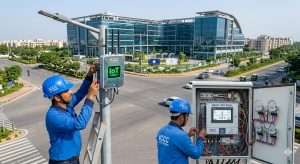
Scale and urgency: India’s urban trajectory
India is urbanising at speed and scale. Projections suggest towns and cities will house some 600 million people by the mid-2030s, with urban areas likely contributing nearly 70% of GDP.
The workforce challenge is just as striking. As of 2025, over 65% of Indian manufacturers are anticipated to adopt digital transformation strategies — yet only 1.5% of Indian engineers currently possess the skills needed for these new-age roles.
India’s overall graduate employability rate has reached 54.81% in 2025, up from 51.25% in 2024 — a meaningful rise, but one that still leaves nearly half of graduates underprepared for industry demands.
For smart cities specifically, India’s IoT market is projected to reach USD 9.28 billion by 2025, and the convergence of IoT and smart city initiatives is driving soaring demand for skills in IoT programming, data security, and integrated urban planning.
The emerging skills portfolio for India’s smart cities
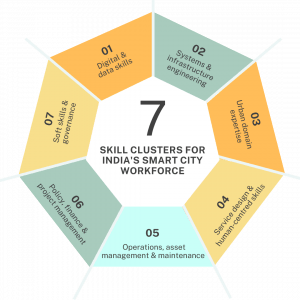
The required skillsets cluster into seven complementary categories:
1. Digital and data skills
Data engineering, analytics, GIS mapping, and dashboarding convert vast sensor-generated data into actionable insights for city operations. Machine learning and AI models further enhance impact by supporting predictive maintenance, demand forecasting, and early anomaly detection — allowing cities to move from reactive responses to proactive, data-driven management.
AI professionals are in particularly high demand, with the global AI market projected to reach $1.81 trillion by 2030 — and cloud computing roles expected to grow by 50% by 2025.
2. Systems and infrastructure engineering
IoT systems integration, network engineering, and cloud or edge deployments form the backbone of modern urban digital infrastructure. Alongside these, strong cybersecurity practices are essential — India faced over 18 million cyber-attacks in Q1 2022 alone, underscoring the urgent need for professionals skilled in ethical hacking, network security, and cyber forensics.
3. Urban domain expertise
Cities need professionals with deep knowledge of water, sanitation, mobility, energy, and waste management who can effectively apply digital technologies within these systems. Their ability to integrate technology while preserving service reliability is essential — the lesson of a newly built Thiruvananthapuram road being dug up shortly after inauguration to fix a sewage leak is a cautionary tale of what happens when infrastructure and operational expertise don’t align.
4. Service design and human-centred skills
Cities require UX designers, human-centred design experts, and community engagement specialists who ensure digital platforms are intuitive and accessible — particularly for women, senior citizens, and differently-abled individuals.
5. Operations, asset management, and maintenance
Urban infrastructure depends on skilled technicians and facility managers who can sustain systems, coordinate upkeep, and manage complex vendor ecosystems. Smart Cities Mission achievements include over 1,740 km of smart roads, 713 km of cycle tracks, and 9,433 smart classrooms across 2,300 government schools in 71 smart cities — all requiring ongoing skilled maintenance.
6. Policy, finance, and project management
Cities require public-private procurement specialists, municipal finance professionals, and programme managers who can plan, contract, and oversee complex urban projects efficiently.
7. Soft skills and governance
Successful urban initiatives rely on professionals skilled in collaboration, change management, and multi-stakeholder negotiation — enabling coordination across municipal authorities, private vendors, and citizen groups.
Pathways to build the urban workforce
Curriculum reform and interdisciplinary training
Universities, polytechnics, and vocational institutes must redesign curricula to include urban data literacy, IoT fundamentals, and applied AI modules contextualised for city problems. Interdisciplinary programmes pairing civil/urban engineering with data science or policy coursework create the hybrid professionals cities need.
India’s working-age population of 15–59 years is projected to rise from 62% to 68% by 2030 — a demographic dividend that can only be realised with the right curriculum investments now.
Industry–government–academe partnerships
Shared training programmes, apprenticeships with municipal utilities, industry-led bootcamps for municipal staff, and joint research projects accelerate skill transfer and create clear career pathways. An Indo-Canadian initiative is already working to train at least 150 urban planners and designers across 20 cities in Punjab, Haryana, and Rajasthan on capacity building, governance, and water supply management — a model worth replicating nationwide.
Scale vocational skilling and technician pipelines
A large share of city operations — metering, streetlight maintenance, sensor upkeep, kiosk servicing — is performed by technicians. By 2025, 50% of secondary and university students are projected to have received vocational training, but this needs to be accelerated and tied directly to municipal hiring plans and contractors’ service agreements.
Upskilling existing municipal staff
A differentiated approach is needed for in-service training: short practical courses for municipal engineers on digital operations, data-interpretation fellowships for city managers, and cybersecurity awareness for procurement staff. This prevents the common failure where new technology is installed but no one inside the municipality can operate it.
Building talent in Tier-2 and Tier-3 cities
Only 18 out of 100 cities have declared full completion of all planned smart city projects — and many of the stragglers are smaller cities hampered by planning, staffing, and vendor challenges. Decentralised training hubs, remote mentoring, and blended learning modalities are essential to grow talent outside metros.
Strengthening public procurement and vendor accountability
Procurement clauses requiring knowledge transfer, local staffing, and long-term capacity building force vendors to invest in skills development rather than merely selling hardware.
The role of the private sector and startups
The private sector and startups play a critical dual role — as providers of advanced technologies and as creators of future-ready talent. Smart city initiatives in Bhopal have attracted investment in the technology sector, creating job opportunities and fostering a startup ecosystem, while Bengaluru’s emphasis on digital infrastructure has supported IT industry growth and positioned it as a hub for innovation.
Beyond deployment, private firms can strengthen the talent pipeline by co-investing in innovation ecosystems — supporting labs, hackathons, and incubators focused on real urban challenges such as energy efficiency, waste management, and public safety. These initiatives improve employability by aligning academic learning with industry needs while accelerating local innovation.
Management graduates show the highest global employability at 78%, followed by engineering graduates at 71.5% — demonstrating that when industry and academia align, the results are measurable.
Key data points at a glance
Conclusion
India’s smart-city transition offers an opportunity far beyond digital dashboards and asset counts. It is a chance to reimagine city work — converting ephemeral project roles into sustainable careers, enabling local governments to run complex digital systems, and ensuring smart services enhance equity and resilience.
Achieving this will depend on deliberate investments in education, vocational pathways, institutional reform, and public–private collaboration. The infrastructure is largely in place. The workforce behind it is the unfinished work.
The success of India’s smart city ambitions will ultimately be determined not by the scale of digital infrastructure deployed, but by the strength and readiness of the workforce behind it. Smart cities are living systems — where technology, governance, and citizens intersect — and they demand talent that can think across domains, adapt to rapid change, and apply technology with social and economic intent.
At PeopleLogic, we help organisations build hiring strategies for roles that didn’t exist yesterday. If your team is navigating digital transformation hiring, we’d love to talk. [Contact us]


