
As 2025 drew to a close, something remarkable had happened in workplaces around the world.
At a tech firm in Singapore, recruiters noticed their hiring dashboards slow. The talent flood of previous years had turned into a cautious stream. Across continents, in Toronto, a healthcare company faced the opposite dilemma — more openings than qualified candidates. They leaned on AI-powered screening to cope, only to realize that technology could identify skills faster than ever, but couldn’t always gauge potential.
And in Bengaluru, India’s own innovation hub, HR leaders at a leading fintech startup faced a paradox of their own. Their AI chatbot handled thousands of candidate queries daily, yet recruiters found themselves spending more time than ever nurturing human connections. As their Head of Talent put it:
“AI helps us find people faster, but empathy helps us keep them.”
These stories echo a shared reality — the recruitment landscape of 2025 was unlike anything before.
It was the year when AI met human ambition, automation converged with empathy, and companies across the globe realized that hiring was no longer about headcount — it was about capability.
As we step into a new year, in this edition of our newsletter,” The People Weekly” the last one for 2025, we will explore the key recruitment and staffing trends that shaped the world in 2025 — how organizations adapted, innovated, and redefined what it means to attract, develop, and retain great talent in an era of constant change.
Global Recruitment Market: A Year of Transition
The year 2025 marked a major inflection point for talent markets worldwide. Businesses everywhere grappled with opposing forces: slowing post-pandemic growth versus rapid technological acceleration.
While AI and automation transformed HR, organizations faced persistent skills shortages—particularly in IT, healthcare, and infrastructure. By late 2024, global hiring had stabilized.
According to LinkedIn data, while year-over-year hiring dipped across most industries, technology showed signs of recovery. Sectors like utilities, education, government, and consumer services remained steady, resulting in disciplined, broad-based hiring strategies.
Top 7 Global Recruitment Trends Defining 2025 and 2026
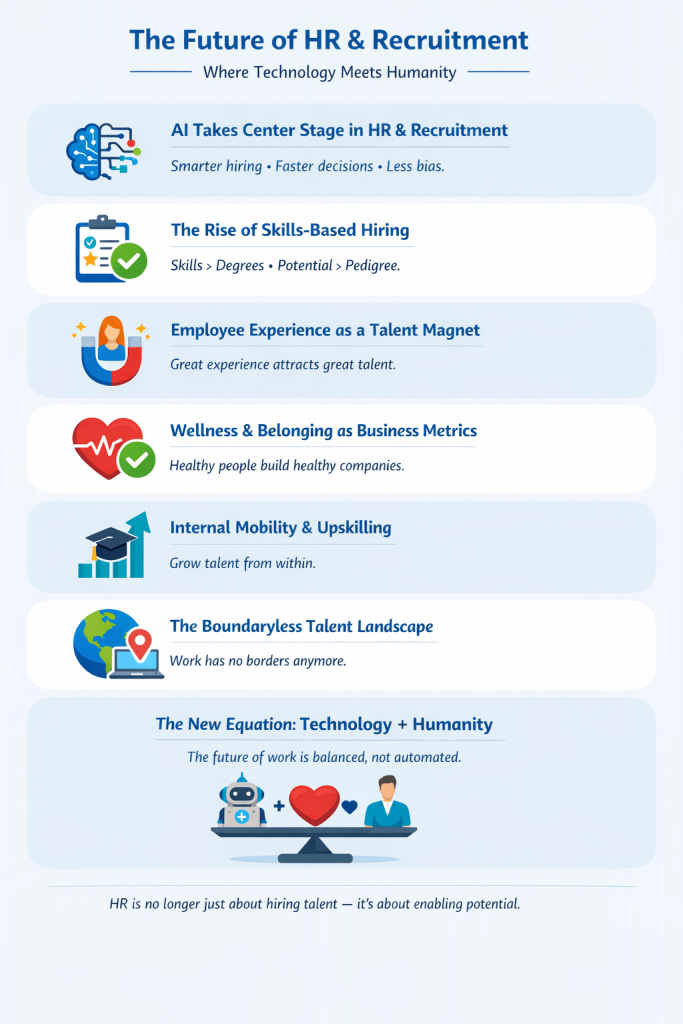
AI Takes Center Stage in HR and Recruitment
One of the biggest stories of 2025 was the rapid integration of AI into HR processes.
The Society for Human Resource Management (SHRM) reported that AI adoption in HR jumped from 26% in 2024 to 43% in 2025.
AI-powered tools for screening, candidate matching, and analytics became everyday essentials — freeing recruiters to focus on high-value work like relationship building and strategic talent planning.
The Result : Recruitment became less about administration, and more about intelligence.
The Rise of Skills-Based Hiring
With the shelf life of skills shrinking fast, skills-based hiring took center stage.
The World Economic Forum projects that 39% of current workforce skills will be obsolete by 2030, prompting employers to rethink what they hire for.
Forward-thinking organizations began breaking roles into skill “bundles”, valuing capability and agility over credentials.
The Result: Degrees mattered less; transferable skills and continuous learning mattered more.
Employee Experience (EX) as a Talent Magnet
HR leaders realized that the battle for top talent extends far beyond job offers — it’s about the employee experience.

Companies like Cisco began using AI to craft personalized employee journeys — from tailored career development paths to AI-driven wellness nudges.Employees who felt valued, supported, and engaged became brand ambassadors in the talent marketplace.
The Result : A strong internal culture became the ultimate recruitment strategy:
Wellness and Belonging as Core Business Metrics
Employee well-being transformed from a side initiative to a core business metric.
Studies show that happier employees are 12% more productive, and companies like Johnson & Johnson reported tangible ROI from wellness programs.
In 2025, mental health, flexibility, and belonging became inseparable from talent retention.
As Cisco’s CPO noted, “Well-being isn’t just a nice to have; it’s the foundation for a high-performance culture.”
Internal Mobility and Upskilling
With external hiring remaining competitive, many companies turned inward.
Investments in learning and development surged — particularly in micro-learning and gamified training modules, often powered by AI.
LinkedIn reported that internal mobility rose 6% year-over-year in 2024, signaling that companies were filling more roles from within.
The most sought-after traits? Emotional intelligence, adaptability, and creativity — human skills that machines still can’t replicate.
The Boundaryless Talent Landscape
By 2025, the talent market has become borderless and hybrid by design.
Surveys by Deloitte, McKinsey, and the World Economic Forum highlighted how candidates now expect:
Flexible, hybrid work models
A purpose-driven culture
Rapid career growth opportunities
However, geopolitical and economic uncertainty continued to push organizations to hire with caution. While AI and tech roles accelerated, routine jobs declined — reshaping workforce strategies globally.
The New Equation: Technology + Humanity
The defining theme of 2025 wasn’t just automation — it was balance.
Companies learned that technology can enhance efficiency, but it’s human connection, purpose, and trust that sustain performance.
The future of recruitment lies in this balance — data-driven intelligence powered by genuine human insight.
India Hiring Landscape 2025-2026: Growth and Resilience
While much of the world approached 2025 with hiring caution, India charted a different path — one of growth, confidence, and structural evolution.
A Surge in Hiring Momentum
India’s job market ended 2025 on a high note.
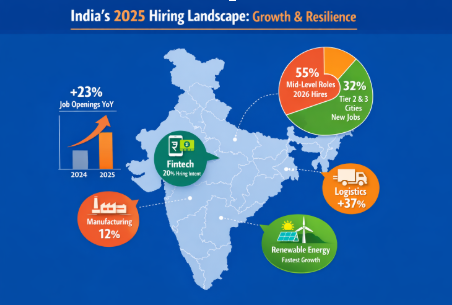
Employment platforms reported a 23% year-over-year surge in job openings across sectors (source) Meanwhile, CII surveys found that overall hiring intent rose to 11% for 2026, up from 9.75% in 2025 (source) . This renewed optimism reflected broad-based confidence. Many organizations moved from replacement hiring to active expansion, particularly for mid-level and senior positions.
Notably, mid-career professionals (6–15 years’ experience) are projected to make up 55% of 2026 hires, up from 39% last year — a clear sign of companies seeking leadership depth and executional agility as growth accelerates.
Tier-2 and Tier-3 Cities Rise as Talent Hubs
A defining trend was the geographical broadening of hiring.
Roughly 32% of new jobs are now emerging in Tier-2 and Tier-3 cities, as companies tap into regional talent hubs beyond Bengaluru, Mumbai, and Delhi.
This shift reflects both cost advantages and the rise of distributed, hybrid work models across India.
Green Shoots: Industries Powering Hiring in 2025
Across regions, certain industries stood out for their resilience and momentum. Let’s look at the sectors driving India’s employment engine in 2025 — and beyond.
1. Technology & IT Services
After a mid-2020s slowdown, India’s tech hiring rebounded strongly.
Specialists in AI, cloud computing, cybersecurity, data analytics, and software development remain highly sought-after.
LinkedIn data shows that tech firms added jobs in 2025 at rates outpacing many other sectors.
Government-backed growth in electronics, semiconductors, and digital infrastructure also continued to boost IT services and engineering roles.
2. Healthcare & Life Sciences
The demand for healthcare talent stayed elevated throughout 2025.
Global trends (including the WEF Future of Jobs Report) forecast strong growth in healthcare occupations, and India mirrored this pattern.
Both public and private healthcare expansions — from telemedicine to health insurance — created a surge in roles for nurses, lab technicians, community health workers, geriatric caregivers, and specialized doctors.
3. Renewable Energy & Sustainability
India emerged as one of the fastest-growing markets for green jobs.
A LinkedIn study found that green-skilled professionals were 59.7% more likely to be hired than the average worker.
Demand soared for solar engineers, EV maintenance specialists, smart-grid engineers, and environmental managers.
Industries spanning technology, utilities, and manufacturing ramped up hiring of sustainability experts as ESG mandates became mainstream.
4. Manufacturing, Infrastructure & Core Industries
The manufacturing and infrastructure sectors fueled much of India’s job creation in 2025.
Government schemes and foreign investment boosted electronics assembly, auto components, and precision manufacturing.
Hiring in logistics and transportation surged by 37%, driven by supply-chain modernization and smart logistics infrastructure.
Large-scale infrastructure projects — spanning roads, housing, and urban development — continued to create demand for engineers, project managers, and skilled tradespeople.
5. Finance, Fintech & Insurance
The finance sector remained a consistent hiring engine.
Both fintech startups and traditional banks expanded teams in risk management, compliance, digital payments, and insurance, reflecting India’s formalizing and digitizing economy.
Globally too, finance and fintech stood out as stable employment sectors amid broader market uncertainties.
6. Logistics & E-Commerce
Fueled by online shopping and quick-delivery platforms, logistics and consumer services experienced a hiring boom.
Roles in warehouse automation, digital fleet management, and last-mile logistics saw rapid growth.
The sector’s expansion also reached smaller Indian cities, reflecting how e-commerce growth is democratizing employment.
7. Social Impact, Education & Public Services
A lesser-discussed but significant trend: non-profit and social impact sectors witnessed outsized growth in 2025.
Corporate focus on CSR and sustainability drove demand for talent in social enterprises and development programs.
Education and public sector hiring — particularly in online learning, skilling initiatives, and government services — remained steady, reinforcing India’s long-term focus on human capital development.
The Road Ahead: Balancing Technology and Humanity
In summary, 2025 was a transformative year for global recruitment—a balancing act between AI-driven efficiency and human-centered empathy.
India’s experience underscored a unique lesson: growth thrives when innovation meets inclusion. As we move into 2026, organizations that combine technology, adaptability, and purpose will lead the new world of work.
Ready to prepare your workforce for 2026? Contact PeopleLogic today to discuss your talent strategy.


